Mostrando entradas con la etiqueta Movies // Películas. Mostrar todas las entradas

martes, 21 de mayo de 2013

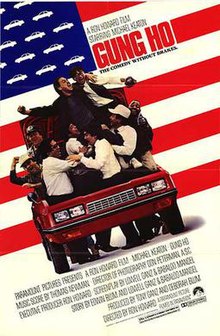
Gung Ho! (Movie 1986) Questions and Answers


  1. What is going on in the opening scene?  What does the screaming indicate about the “Japanese work culture”?

Michael Kenton has a meet with Japanese leaders to make business. Japanese are very serious and strict and do not get Kenton’s jokes.
  1. Describe two cultural differences Micheal Keaton encounters when he meets the Japanese Board of Directors.

a) Japanese are more formal.
b) Japanese are more serious about money issues and business.

  1. Why did Micheal Keaton go to Japan?  What were the problems with his home town of Hadleyville?

Michael Kenton went to Japan to sell the Assian managers on the idea of coming to Hadleyville and reopen the factory. The problem was that Hadleyville factory has been closed for the last nine months and lots of people has lost their jobs.

  1. How does the car factory closing affect the town of Hadleyville?  What is the evidence is shown in the grocery store scene to illustrate the problems?

A great plenty of people in Hadleyville work in the car factory, so they may lost their jobs.

  1. Why was Micheal Keaton promoted?

Michael Kenton was promoted to work as a liaison between the Japanese management and the American workers, to make the transition easier for both and convince the workers to obey the new rules.

  1. Describe what is occurring at the workers’ meeting.

American workers do not want to work for Japanese people, get lower pays and have to work harder. Michael Keaton takes an important role and promises to discuss and make the transition easier.

  1. Describe four cultural differences that occur on the first day of work.  Why are the American workers laughing?

a) Japanese executives eat their lunches with chopsticks
b) Japanese executives bathe together at the river
c) Kazihiro says that they are a team and they should work as a team.
d) Callisthenics in the morning.
American workers laugh because it is strange for them these things and do not get the point of doing callisthenics in the morning.

  1. Why do the Japanese install close circuit cameras in the factory?  What does this indicate about trust?

This way Japanese can keep an eye on the USA workers. Japanese people do not trust the American.

  1. How does the music in the factory, the newspaper in the bathroom and smoking by the American workers contrast with the Japanese factory culture?

Japanese are shown very loyal to the job. They work hard and with no distractions at the workplace. All the funny things happen outside the timework.


  1. Why do the Japanese initiate a job rotation among the factory workers?

Because this way every work can learn every job. Although, they are held to seemingly impossible standards of efficiency and quality.

  1. How important is quality to the Japanese?  What evidence is there to support the importance of quality?  How does the focus on quality contrast with the workers old-style culture?

Quality is the most important thing for Japanese.
The Assan boss revises all the cars one by one.
Old-style workers only want to have work done to get paid. They do the minimum they can do.

  1. State the differences between the factory workers and the management teams at the baseball game.  What does the differences between the two groups signify?

Buster cheats when he intentionally knocks a man down. Rather than contest the incident, the Japanese accept the loss and leave. The American workers want to win anyway and the Japanese want to win but following the rules.

  1. Why do the women leave the table at the dinner party?  Why does Keaton’s spouse get upset about this?

Because they think business is only for men and women have nothing to say about them.

  1. Why is Micheal Keaton fired?

Michael Keaton is fired because he did not reach the goal at time.

  1. Why does Keaton meet the Japanese management team in the river?

Because the Japanese man is going to suicide himself. But rather than focusing on their differences, they decide to focus again on their shared goals and return to the factory to build more cars.


sábado, 2 de marzo de 2013

Pay it forward

    The film “Pay it forward” is about a child, called Trevor. Most young children want to change the world for the better, and Trevor's teacher gives him the opportunity to do so. His social science teacher gave him an assignment for all the course to think of something that could change the world. Trevor's idea was not to pay back a good action, but to pay it forward to three more people else and to do it for nothing in return. This kind of actions, with no pay back expected, only a pay it forward, created an outward, positive force of change; change for the good, kind of a utopia world. Trevor tried and managed to help three different people.  At the end of the movie, Trevor is killed by a stab. The director tries to show us that this idea and the world that Trevor tries to create  is too much utopian.

I believe the concept of pay it forward is quite interesting. It is all about passing it on.  Instead or paying "back" someone for a good deed they instead do a good deed for 3 more people and so on. It does not have to be big, or take lots of time, it can be something really simple. But do it, because kindness is usually contagious. When people feel good, they tend to do good. As people do good to others,  there are more chances the receivers will also do good to others. This creates a cycle of kindness and charitable acts. No matter how small, each act even though the smallest, has the power to transform a community, a city, or even the world, into a better place.

It can be the simplest of things that work to improve the current or future state of an another individual. Imagine for a moment that you are having a bad day. The smallest, most minuscule, compliment from a stranger may brighten your day. These random acts of kindness can transform a negative attitude. They can changed all our day.


jueves, 31 de enero de 2013

Rain Man versus I am Sam


Rain Man and I am Sam are two films in which the main characters are autistic. Both movies are about relation between autistic and non-autistic people and in both it is demonstrated that these people in spite of having difficulties in relationships they are able to do much better than we think.

In both films there is a problem between two family member who cannot stay together. In both cases the older member has a mental disorder, Sam and Raymond, who are autistic and have problems to be “normal”. And the younger, Lucy and Charlie can act in a normal way. The head of the families, Raymond and Sam, have money problems but for very different reasons.

In I am Sam the relationship is between a father and a daughter, and in Rain Man it is between two brothers. Both have problems to stay together, but there is a big difference: In I am Sam Lucy and Sam want to remain together, but on the other hand, in Rain Man Raymond does not want to stay with Charlie and wants to go back to his residence where he has lived for over twenty years. Charlie neither wants to stay with Charlie for family purposes, he only needs Raymond to get half of his dead father’s inheritance. Charlie needs money to rescue his car business and Sam needs it to pay Rita Harrison, his lawyer, although finally she works for free, because she gets in trouble during a celebration and says in public she will help Sam for free. In I am Sam  a family problem creates a money problem, whereas in Rain Man a money problem creates a family problem. Sam does not need extra-money until he needs to hire a lawyer and Charlie is not interested in Raymond until he realizes Raymond has received the inheritance. Furthermore Raymond, despite of being great with numbers, does not understand the concept of money so he wont use the $3millions.


In both films the big problem lies with main characters; Raymond and Charlie, and Sam and Lucy; have a problem to stay together because of the disabilities and difficulties to interact with people.

In Rain Man  the custody battle starts with a money problem and in I am Sam because at Lucy's seventh birthday party, friends from school are invited and several mock Sam and Lucy. Seeing Lucy hurt and angry, Sam justifiably punishes the offending child. The child's parents' already uncomfortable with Sam, target him an unfit father. Sam gets in trouble and Lucy is placed under a court protection. Luckily Sam is encouraged by his friends, his neighbour Annie and his lawyer Rita. Rita’s support is very important because Sam almost quits in his fight to recover Lucy, but Rita manages to change his mind when she goes to his apartment and destroys the door with a kick. On the other hand, in Rain Man, Charlie is not encouraged by anyone and in addition Susana breaks with him because of the way he treats his brother Raymond.


Sam and Raymond are autistic and have some problems to interact with nervous people. Both get nervous with stress: Sam preparing coffees and Raymond when Raymond shouts at him or when he stops in the middle of the road when the traffic light says “don’t walk”. Because of their mental disorders they have problems to interact with people from the other sex. As the movies progress, both improve, Sam obtains lots of confidence with Rita and Raymond kisses a woman for the first time. A good characteristic of Sam and Raymond is that they cannot tell lies, they are very honest and frank. Everything that they say is what they think. Further more both had problems with their parents: Sam was educated in a special school and Raymond was sent to the residence when he almost burnt Charlie when he was two. Sam and Raymond like most of mentally disabled people, have to follow a routine.

The big difference between Sam and Raymond is their lifestyle. Raymond lives in a special residence where there are doctors taking care of him. On the other hand, Sam lives a normal life and has to work to obtain money, has a daughter, an apartment… Raymond does not have any responsibility and Sam has to take care of Lucy. Raymond has to follow a very strict routine: he has to do always the same at the same time. Also he has learnt some things that he cannot do, for example flying in planes or going out when it is raining. This becomes a problem for Charlie who has to be more flexible and adapts himself. Instead of that, Sam also has to follow a routine but it is not the most important thing of his life, although if the routine changes he gets nervous. For example, one day Lucy wants to have breakfast in a different place, finally Sam agrees but when he is asked about what he wants and the waitress cannot bring his order he becomes mad. Although he has changed since the beginning of the movie and it is possible to realized it when a Thursday night he stays with Rita instead of going with his friends to watch a movie.


Rain Man and  I am Sam teach us that people with mental problems are not less qualified to maintain a relationship. The relationship may be different because they are different, but actually no relationship can be catalogued as normal. People like them may have some difficulties about money or how people spend their time. But they also, and this is their best quality, cannot tell a lie so they are great people to have at your side. Because of their personality they can change people around. Raymond changes Charlie and Sam changes Rita. In Rain Man, at the beginning Charlie only wants to stay with Raymond because of money but he has a change of heart during the movie. Charlie at the beginning is very undemonstrative but little by little he starts to open his mind with Raymond and at the end he loves Raymond like a brother and no matters his problems. Further more, in I am Sam, at the beginning Sam is treated by Rita like a subnormal and she thinks that in any way Sam could be a good father. Through the story Rita realized Sam is a better parent than she is and also Sam helps Rita in the decision of breaking down her marriage. In some cases disabled people are better than “normal” people.